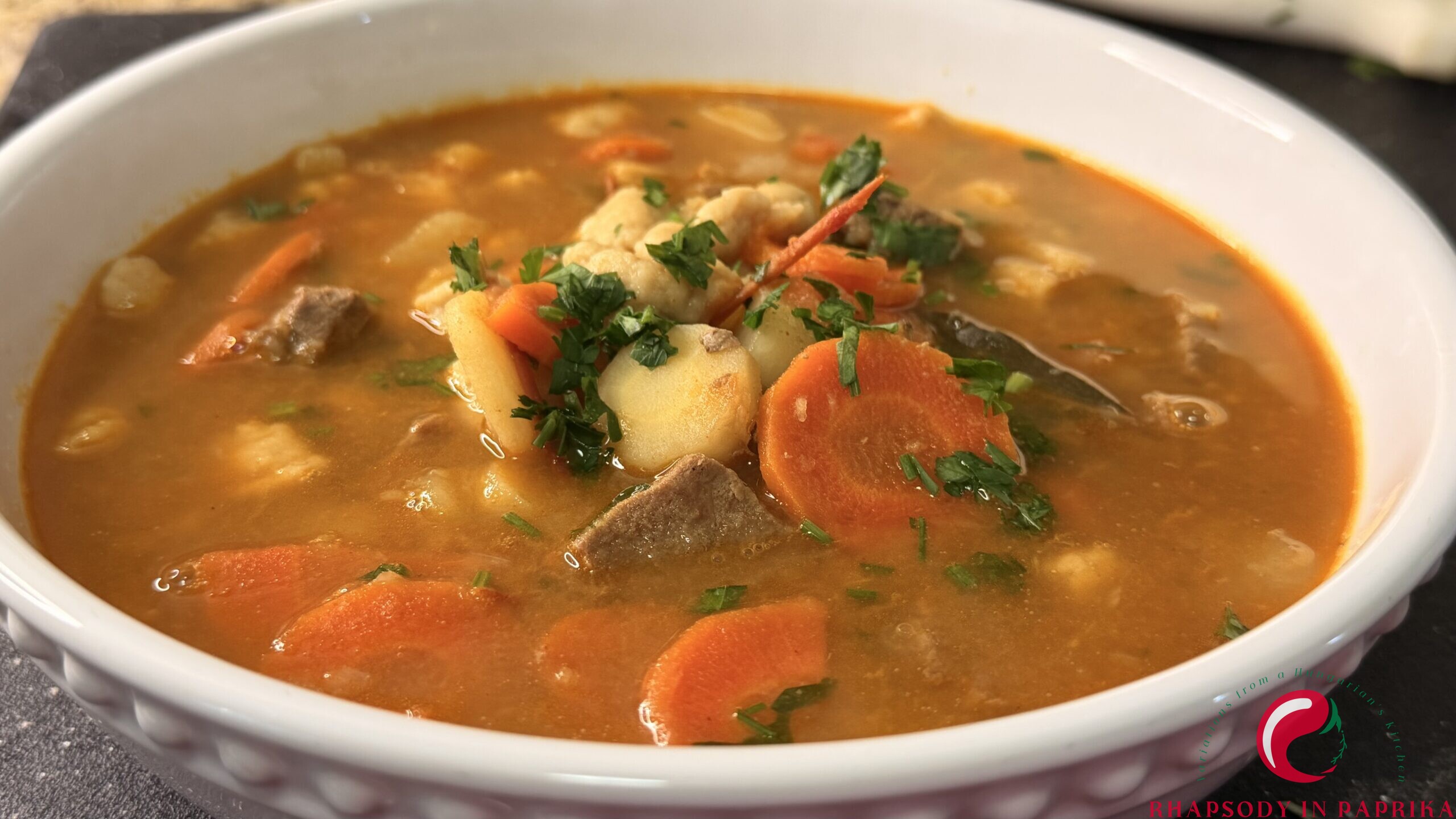
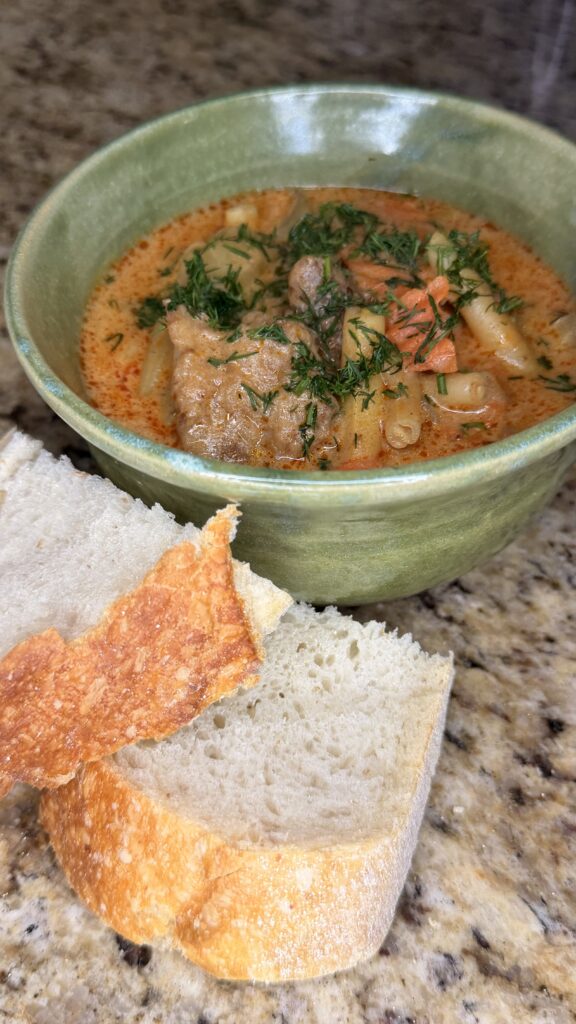
Palóc Soup: From Gundel’s Kitchen to My Version
Some dishes are born from centuries of tradition. Others become tradition because someone, at the right moment, decides to create something new.
Palóc soup belongs to the second category.
Today, palócleves feels unmistakably Hungarian: paprika, tender meat, potatoes, green beans, sour cream, herbs, and a bright, pleasantly sour finish. It is the kind of soup that seems as though it must have been cooked in Hungarian kitchens forever.
But its story actually begins in Budapest at the end of the 19th century — with the Gundel family and one of Hungary’s most beloved writers, Kálmán Mikszáth.
From a birthday dinner to a Hungarian classic
The story most closely associated with the soup dates its creation to 1892, when restaurateur János Gundel prepared a special soup for Mikszáth. Mikszáth was closely associated with the Palóc people of northern Hungary and was often referred to as the “great Palóc,” which eventually gave the soup its name. Gundel’s own historical account says that Mikszáth wanted a soup that captured the flavors of Hungarian cooking, and Gundel created one especially for him. (Gundel Cafe Patisserie Restaurant)
The earliest version was quite different from many bowls of Palóc soup served today. Gundel’s historical material describes a preparation built around mutton, green beans, potatoes, vegetables, paprika and sour cream, while another Gundel account describes the original meat as goat, with lamb becoming the practical modern substitute due to its mild taste. Historical accounts therefore don’t agree completely on the precise original recipe — but they consistently connect the dish to János Gundel, Mikszáth, and the late-19th-century Budapest restaurant world. (Gundel Cafe Patisserie Restaurant)
And there is an important distinction here:
Palóc soup was not originally a traditional Palóc folk dish – however the soup uses potatoes and wax string beans that is common to this region.
It was a restaurant creation named in honor of Mikszáth and his connection to the Palóc region. Over time, however, it became so thoroughly absorbed into Hungarian cooking that it acquired the feeling of something much older.
The Gundel family develops the soup
The soup did not remain a one-night birthday creation. – János Gundel’s son, Károly Gundel, helped establish Palóc soup as a recognizable part of the Gundel culinary tradition. The family’s history records that the dish was already appearing on the menu by the opening of the Mikszáth Room in 1894, and that Károly Gundel presented it at a restaurateurs’ dinner competition in 1935, helping propel it beyond its original setting. (Gundel Cafe Patisserie Restaurant)
That evolution is important because the Palóc soup we recognize today isn’t necessarily a frozen snapshot of what János Gundel served in 1892.
Instead, it became a template.
The essential character remained: meat, potatoes, green beans, paprika, sour cream and a lively acidic note. But cooks began adapting the details to the ingredients available to them and to their own style.
Recipes that followed show considerable variation. Lamb, mutton, pork and beef all appear in later versions. Some include carrots and parsley root (the Hungarian fehérrépa, or parsnip/root parsley), while others keep the vegetable list much simpler. Some use dill prominently; others use parsley. Some thicken the soup with a flour-and-sour-cream liaison, while others simply enrich it with sour cream at the end. (borsmenta.hu)
Even the sourness has evolved.
Older versions commonly used vinegar, while modern recipes frequently turn to lemon juice for a cleaner, fresher acidity. Some contemporary recipes use both approaches, and the current Gundel preparation itself emphasizes acidity as an important part of the soup’s character. (Gundel Cafe Patisserie Restaurant)
The modern Gundel version has continued that spirit of refinement. Today, Gundel describes its Palóc soup as a lamb-based soup built from an intensely flavored lamb stock, sour cream, yellow beans, potatoes and root vegetables, finished with vinegar-marinated purple potato and fresh herbs. It is presented as both a historic dish and one of the restaurant’s national Hungarian classics. (Gundel Cafe Patisserie Restaurant)
From one recipe to many
That may be the most interesting part of Palóc soup’s history. There isn’t really one immutable recipe. There is a family resemblance.
The soup has traveled from:
János Gundel’s celebratory creation
↓
Károly Gundel’s refinement and popularization
↓
20th-century Hungarian cookbook versions
↓
regional and home-kitchen adaptations
↓
today’s lamb, pork and beef versions
↓
modern interpretations that play with acidity, herbs and vegetables
And that makes Palóc soup particularly fun to cook today. You can respect the architecture of the original while allowing the soup to evolve.
My version
For my version, I wanted to stay connected to that history without trying to recreate the 1892 bowl exactly.
I use beef chuck instead of the traditional lamb or mutton. Chuck brings the deep, slow-cooked beefiness that works beautifully with paprika and sour cream, while its connective tissue gives the broth body as it cooks. I keep the classic potatoes and green beans, but add carrot and parsnip for a sweeter, more rounded vegetable foundation.
And instead of vinegar, I use lemon.
That last change is small but significant. The lemon gives the soup a clean, bright acidity that cuts through the richness of the beef and sour cream without making the soup taste overtly “sour.”
The result is recognizably Palóc — but it is not trying to pretend it is 1892.
It is simply the next chapter.

Modern Twist on a Historical Soup – Palóc Leves
Description
The idea behind the bowl
The original Palóc soup was created as a tribute to a person.
Over more than a century, it became a tribute to something larger: the ability of Hungarian cooking to balance richness with freshness, paprika with acidity, and hearty ingredients with herbs and sour cream.
So while this version uses beef chuck, carrot, parsnip and lemon rather than the ingredients of Gundel’s original, the spirit remains remarkably close.
A dish created for Mikszáth in 1892 became a Hungarian classic — and now, like all living classics, it continues to change.
Ingredients
Instructions
-
Build the paprika base.
-
Heat the lard or oil in a heavy pot over medium heat. Add the onion and a pinch of salt and cook until soft and translucent. Add the garlic and cook for another 30 seconds.
-
Add the beef.
-
Add the beef chuck and season with salt and pepper. Cook until the meat is lightly browned and coated with the onion mixture.
-
Add the Hungarian aromatics.
-
Remove the pot briefly from the heat and stir in the paprika and crushed caraway seeds. This keeps the paprika from scorching and turning bitter. Add the bay leaf.
-
Begin the slow cook.
-
Add enough beef stock to just cover the meat. Bring to a gentle simmer, cover, and cook slowly until the beef is beginning to become tender, about 60–75 minutes.
-
Add the root vegetables.
-
Add the carrots and parsnip and continue simmering for about 10 minutes.
-
Add the potatoes and beans.
-
Add the potatoes and green beans. Continue cooking until the beef is completely tender and the vegetables are cooked but still retain their shape, roughly another 15–20 minutes.
-
Finish with sour cream.
-
Whisk the sour cream and flour together in a bowl. Temper it with a ladle or two of the hot soup, whisking constantly, then slowly stir the mixture back into the pot. Simmer gently for several minutes. Do not let it boil aggressively once the sour cream has been added.
-
Bring in the acidity.
-
Stir in the lemon juice a little at a time. The goal isn’t to make the soup taste lemony; the lemon should simply sharpen the flavors and balance the richness of the beef and sour cream.
-
Finish with herbs.
-
Stir in the dill and parsley. Taste and adjust the salt, pepper and lemon.
-
Rest before serving.
-
Let the soup sit for 5–10 minutes before serving. The flavors settle and the broth becomes even more cohesive.
-
Serve hot, with an additional spoonful of sour cream and a little fresh dill if desired.